
|
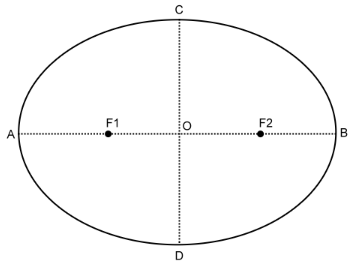
An ellipse is one of a family of mathematical curves known as conic sections as illustrated on the right. It is a symetrical oval shape having two principal axes and two points, each a focus. The Sun is at one of these. The two principal axes are the major axis, AB, and the minor axis, CD. Half these are known as the semi-axis major, designated a, and the semi-axis minor, designated b. The position of the focus, say F1, is such that OF1/OA = e, the eccentricity, itself defined as e = √(1 - b²/a²). e is a number between 0 (a circle) and 1 (another curve called a parabola). |
 |
|
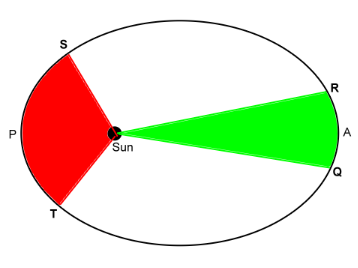
This law sounds very complicated but is only so because it is quantitative. It is illuntrated on the right. If the areas of the sectors I have coloured red and green are the same, then the planet takes the same time to go from Q to R as it does to go from S to T. What this means qualitatively is that the planet moves more quickly when close to the Sun than when further from the Sun. In the diagram the point P, the closest point to the Sun, is called the perihellion, and the furthest point, A, is the aphelion (pronounced ap-helion). |
 |
|
What this means in simple terms is that the orbital period, P, of a planet is related to its distance from the Sun, R, by the equation P² ∝ R³. If the orbital period is measured in years, and the distance in Astronomical Units (AU), then the equation becomes P² = R³. Bode's Law yields the distance from the Sun in AU and this relationship gives the period in years. To a close approximation anyway.
|