
The reason for this contention is that if a hypothesis is not true, then sooner or later a fact will be found that is contrary to the statement in the hypothesis. However, if it is true, however many facts are found that are consisent with the hypothesis, that does not prove that no fact will ever be found which is contrary to it. The word easily may be a gross exageration; finding a fact that is conrary to the hypothesis may be very difficult.
My example of this is Bode's Law. This was not discovered by Johann Bode, who freely admitted that he got it from Johann Titus, so it is sometimes called the Titus-Bode Law. But Titus did not originate the law either and it is obscure where he got it from, so I will continue to call it Bode's law. What Bode did do arround 1772 was to popularise the law published by Titus in 1766. It is an empirical relationship which yields the distances of the planets from the Sun
Table 1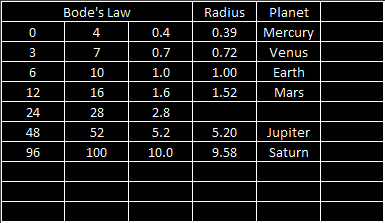 |
The relationship goes like this. Start 0, 3, 6, and then each number is twice the previus number and this is shown the the first column of Table 1. Now add 4 (second column) and divide by 10 (third column). Compare these with the distances of the planets from the Sun, in Astronomical Units (A.U.), given in the fourth column. The agreement is remarkable, and the gap at 2.8 A.U. caused some speculation at the time. The attitude at the end of the eighteenth century can be summed up by a comment by Titus "Can one believe that the Founder of the Universe had left this spece empty? Certainly not". And, if I may paraphrase futher comments at the time, "and if he did, who are we to question his motives?". |
Table 2 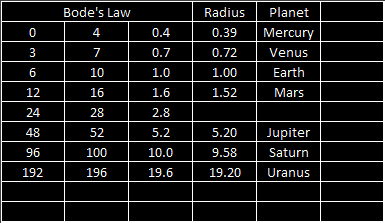 |
Table 1 covers only the planets out to Saturn because those were all that were known in Bode's time. One of the most important things a new theory must do is to predict something not currently known, which is later verified as true. Not long after Bode popularied his law, in 1781 William Herschel discovered Uranus. Its distance from the Sun was measured and added to Bode's sequence (Table 2). The agreement is close and this is a modern value; at the time the distance woud have been more uncertain. So Bode's Law has passed its first great test. One should, of course, say that Bode's Law lacked, and still lacks, any theoretical justification. However this success fueled even more speculation that an unknown planet existed at 2.8 A.U. A group of astronomers decided to make a concerted search for such a planet. Before he received his invitation to join the group, Giuseeppe Piazzi, a Catholic priest at the Academy of Polermo in Sicily, found a star that was not on his star map on 1st January 1801. Observing the object for the next month convinced him it was moving and he thought he had discovered a comet. He told two others about it by letter at the end of January, one of which was Bode. In April he published all his observations in a German astronomy magazine. However by this time the object was too close to the Sun for further observation and it was lost. The great mathematitian Carl Friedrich Gauss, then only 24, had developped an efficient way to calculate orbits and he analysed Piazzi's observations and predicted when and where the object could be found. It was found again, named Ceres and its distance from the Sun calculated. I have included Ceres in Table 3. |
Table 3 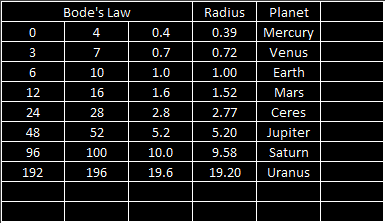 |
You can see from Table 3 that Ceres fitted almost perfectly with Bode's prediction. It might be argued that Bode's Law did not actually predict the presence of Uranus, but it did predict the prescence of Ceres and its distance from the Sun and it got it right. This was strong evidence that Bode's Law might be right, but does not prove it. There is still no theoretical basis for it, but that doesn't prove it wrong. |
Table 4 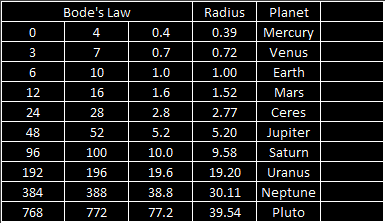 |
In 1846 Neptune was discovered. I have added Neptune and Pluto in Table 4. You can see at once that Neptune is not where Bode's law says it would be. So, despite all the previous successes of the law, we have one fact that does not fit and Bode's Law is dismissed as rubbish. You can see that Pluto is an even worse fit to Bode's prediction. |
Table 5 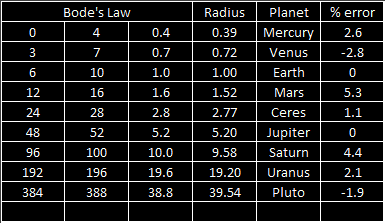 |
So Bode's Law has been dismissed as an interesting coincidence. But what if we pretend Neptune does not exist? Table 5 shows that then Pluto is almost exactly where the Law says it should be. In the final column of Table 5 I show the percent deviation of each planet from the law's prediction. You can see that Pluto is a better fit than any other planet except Jupiter and Ceres. (Earth doesn't count as it is true by deffinition.) One could suggest that, whatever the influence that causes the planets to take up the positions predicted by the Law, it becomes very weak at the outer parts of the system and that Neptune has not yet had time to move out to where it should be. The Law is also useful in emphasising just how big the solar system is. Each planet is roughly twice as far from the Sun as the previous one. This is not so true in the inner part but becomes increasingly true for the giant planets and beyond. Thus Saturn is almost twice as far from the Sun as is Jupiter, and Uranus is twice as far as Saturn. |
I have told the story of Bode's Law in some detail because I think it makes an interesting story, but the point is that the idea was very successful in correctly predicting the distance of Uranus and causing the search for a planet at 2.8 A.U. which was successful. The discovery of Ceres did not stop the search for a planet at that distance because it was evidently a very small body and the team thought there should be a bigger one. They found Pallas in 1802, Juno in 1804, and Vesta in 1807. Many more were found over the years and currently more than a million are known most of them in the asteroid belt at an average distance of 2.8 A.U. Despite these successes Bode's Law is currently classed as discreditied, but I think it has its uses. In particular it is an aide to remembering the distances of the planets from the Sun and can be used for a quick metal calculation if asked at an outreach activity.
It can also be that a theory, although strictly false, is so good that it can continue to be used with good effect. An example is Newton's Theory of Gravitation. It is simple and accounts well for most observations. However it fails to account exactly for the orbital motion of Mercury and Einstein's theory of General Relativity accounts for the motion more nearly. However Relativity is much more complicated to calculate and is seldon necessary. For example, the New Horizons spacecraft waas sent to Pluto using trajectories calculated entirely by Newton's theory and, not only did it get there, it got there within 1 second of when it was predicted to do so. An important achievement of Newton's theory, when he first proposed it, was that he was able to show that his Law of Gravity cound be used to derive the three laws of planetary motion which Kepler had deduced from detailed observations some 70 years earlier. It fails to account for all known phenomena but is good enough for most practical purposes.