
My purpose here is to discuss the four theories of the origin of the Moon which have been current over the last 125 years. But first some introductory material.
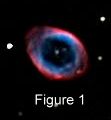
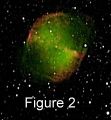
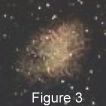
| Some thirteen thousand million years ago the universe popped into existance and created the lightest elements, Hydrogen (75%), Helium (23%) and Lithium (2%) and nothing else. Stars formed from these gases and created Carbon, Oxygen, and Nitrogen, on which life now depends, and in lesser amounts the heavier metals, like Magnesium, Aluminium, and Silicon. All these elements were returned to the interstellar medium through planetary nebulae (Figures 1 and 2) and supernova explosions (Figure 3). This material was incorporated into the next generation of stars and so the amounts of these elements gradually increased and they reacted together to form simple molecules like Methane, Ammonia, Water, and the metal oxides and silicates that make up the planet on which we live. |
   |
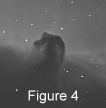 The Sun is believed to be a third generation star, so, when it formed by the collapse of a great cloud of interstellar gas, that cloud contained a lot of metals and their compounds. (I should perhaps mention that to an Astronomer any element not hydrogen or helium is a metal.) The smaller compounds like ammonia, methane, or water, would have remained as gases, but the metal oxides and silicates would have stuck together to form small bits of dirt that astronomers call dust. This is opaque to light and we see it as dark nebulae such as shown in Figure 4. As the Sun formed (and this applies to all stars) a small proportion of the material missed the central core as it fell inwards and went into a disc of material revolving around the Sun. This disc broke up into ever-growing lumps as gravity caused the bigger lumps to grow at the expense of the smaller ones. Hence the planets formed and evolved to form the solar system we know. It is thought that the regular satellites of the major planets formed in much the same way as the planets themselves formed.
| Throughout most of the twentieth century there were three contending theories for the origin of the Moon. They became known by the familiar names shown in the adjacent table. (It has been suggested that these names are too gender specific and either the male equivalents or gender-neutral terms could be used, but they are of their time.) |
|
There are a number of properties of the Earth-Moon system, which must be explained by or be consistent with any successful theory of the Moon's formation. I don't want to list all these so will simply mention for each theory the ones that actively support the theory and those that are clearly inconsistent. Two general points have to be made, however. Firstly, the Earth is a differentiated body (it has a dense iron core overlaid by lighter rocks), which must mean that is was liquid at some point in the past. Secondly, the average density of the Moon (3·3) is much less than the average density of the Earth (5·5).
This theory was originated by Sir George Darwin, son of the more famous Charles Darwin. He was very eminent scientist in his own right. He proposed that at some point in the past, when the Earth was molten and had differentiated, it's rotation speed increased (by what mechanism is unclear) and this caused it to stretch out into a cigar shape and eventually became so great that a small lump detached from one end to become the Moon. The Earth's rotation then decreased and the Moon moved further away by the same mechanism of the tides, which is still operative today. This theory accounts for the lower density of the Moon but is inherently unlikely. A spinning liquid globe would not form a cigar shape but would become a disc. This might become great enough for a ring of material to detach itself from the spinning disc and this material might collect together into the Moon. Indeed there is good evidence that the Moon did indeed form by the aggregation of smaller pieces. Whether such a mechanism is physically possible, I do not know.
This theory proposes that the Moon formed at the same time as the Earth by accumulating with the Earth as a double planet. This seems eminently possible and is essentially the same as the way the major satellites of the giant planets are assumed to have formed, and there are several double asteroids known. However, if the Moon formed near the Earth, one would expect it to be made of the same material of which the Earth is made, but it is not. It lacks the heavy iron core that the Earth has and its density is much lower.
This theory proposes that the Moon formed elsewhere in the solar nebula but came too near to the Earth and was captured. There are two major objections to this idea. Firstly, how would such a capture occur? As anyone who follows the space probes that are sent out to orbit a planet will know, such a probe has to have an engine on board, which is used to slow the probe down as it approaches the planet in order to allow it to be captured. Without this the probe swings around the planet and goes away again in what is known as a slingshot manoeuvre. So if the Moon is to be captured there has to be a way for it to lose energy. For the giant planets there were the other satellites to which an incoming asteroid could lose energy, but there was no such satellite with the Earth. One might suggest that it ploughed through the atmosphere and lost energy that way, but it would have done so at the closest approach in all succeeding orbits and would eventually have spiralled into the Earth. Another possibility is that the Moon was a double object and one part lost energy to the other, which was ejected from the system. Possible but not very likely. There is one more convincing objection.
Study of meteorites has indicated that different parts of the solar nebula had differing ratios of the isotopes of the elements, in particular of Oxygen. The two isotopes of Oxygen are known as Oxygen-16 (16O) and Oxygen-18 (18O). The ratios of these two isotopes are different in the meteors from different meteor streams. Thus, if the Moon formed elsewhere in the solar nebula, we would expect it to have a different ratio of the isotopes than the Earth does. We now have samples brought back from the Moon and they are identical; not just similar, identical. We must conclude that the Moon was not formed remotely from the Earth.
Since none of the traditional theories is fully satisfactory, indeed each has over-riding objections, a new theory was proposed in 1976 and became popular after 1984. This suggests that after the Earth had differentiated and solidified, it was struck by an object about the size of Mars. This object was itself differentiated and has been given the name of Theia (who in Greek mythology was the mother of Selene, the Moon). The impact caused a huge cloud of debris to be shot into space and melted both the Earth and Theia, which merged into a single body. A proportion of the debris went into orbit around the enlarged Earth and eventually coalesced to become the Moon. Whilst this theory accounts for many of the features of the system, it struggles to explain the oxygen isotope issue. If Theia formed elsewhere in the solar nebula then it would be expected to have a different ratio from the Earth. In this case, the only way for the Earth and the Moon to end up with exactly the same ratio would be if they were each formed from exactly the same proportion of Earth and Theia. Somehow unlikely.
In 1986 John Wood gave each of the theories exam scores for how well they accounted for 6 properties of the Earth-Moon system plus a score for Physical Plausibility. In 2003 Charles Wood (no relation to John) took John Wood's scores, gave them a numerical value, averaged them and converted them back to an exam score. The results were Fission C+, Co-accretion C+, Capture C-, Impact B+. Thus the Giant Impact theory wins by a significant margin, but it is still not an A. However its final score is an average of only 5 of the 7 individual scores, whereas the older theories are the average of all seven. This arises from the fact that John Wood felt that there was insufficient evidence to give a score for the other two criteria, the Moon's mass, and its relative lack of iron. The result would be rather different if these were both given A or D. If both are given an A, then the average would be pulled up to an A-, but if given a D the average would be a B-. It would be somewhere in between so would still come out top, and, in one form or another, is now believed by most lunar authorities. My personal opinion is that it is being too dogmatic to state "The Moon was formed when an object the size of Mars collided with the early Earth". Maybe it was, and it is the best idea so far, but to me it is not entirely convincing. It is interesting to note that it has been suggested that the two satellites of Mars could have been formed by a similar mechanism. It is also suggested that a giant impact tipped Uranus over on to its side, and reversed the rotation of Venus. The early solar system was certainly a chaotic place so impacts of this kind are not so unlikely.